The Misconception of "Normal": Understanding the Spectrum of Human Behavior
🤔 "Normal" behavior is a myth. This article explores the vast spectrum of human behavior, challenging preconceived notions and illuminating the diversity…
Read article
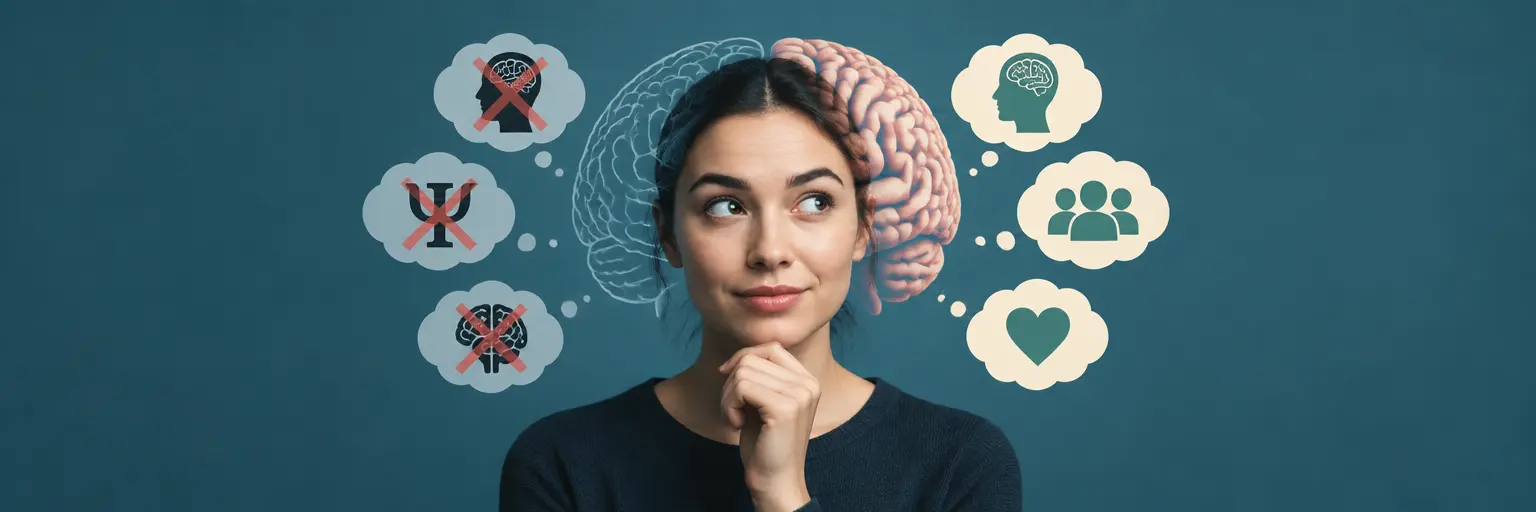
Psychology is often misunderstood, surrounded by myths that blur the line between science and everyday folklore. In this section, we bust common misconceptions about psychology—from the idea that it’s just “common sense” or mind-reading, to believing that only “crazy” people need therapy. Here, you’ll discover why psychology is a rigorous, evidence-based science that studies behavior, thoughts, and emotions—not a crystal ball. We’ll clarify why memory isn’t a perfect recording, why opposites rarely attract, and why we only use 10% of our brain is a myth. You’ll also learn why hypnosis isn’t mind control and why mental illness isn’t a sign of weakness. By unmasking these errors, you’ll gain a clearer, more respectful view of human nature and the scientific method behind modern psychology. Whether you’re a student or a curious reader, this guide helps you separate fact from fiction, making psychology more accessible, practical, and fascinating. Discover how real psychological research contradicts popular sayings, and find out why understanding these myths matters for your mental health, relationships, and daily decisions. Dive in to think smarter about the mind and behavior.

🤔 "Normal" behavior is a myth. This article explores the vast spectrum of human behavior, challenging preconceived notions and illuminating the diversity…
Read article
🤔 Psychology's foundation rests on rigorous research. This article explores evidence-based practice in psychology, clarifying its crucial role and impact on the…
Read articlePsychology is one of the most fascinating yet misunderstood fields of science. From movies and pop culture to casual conversations, myths about psychology spread quickly, shaping how people view mental health, behavior, and therapy. This subcategory is designed to dismantle those pervasive misconceptions, replacing them with evidence-based clarity. Whether you’re a student starting your psychology journey or a curious reader, you’ll discover why psychology is a rigorous science, not a collection of parlor tricks. Here, we tackle the most common false beliefs—from the “left-brain/right-brain” myth to the idea that psychology is just common sense—so you can think critically and confidently about human behavior.
Many people assume that psychology simply states what everyone already knows—like “opposites attract” or “birds of a feather flock together.” However, psychological research often reveals counterintuitive truths that challenge our intuition. For instance, studies show that people are more likely to help others when in a group of strangers than when alone, contradicting the “bystander effect” myth. This H3 section clarifies that psychology uses rigorous methods—controlled experiments, longitudinal studies, and statistical analysis—to uncover patterns that are anything but obvious.
By debunking the “common sense” misconception, you’ll learn to appreciate the scientific backbone of the discipline. Real psychological findings frequently overturn folk wisdom, such as why rewards can diminish intrinsic motivation or how memory is reconstructive, not a perfect recording. This isn’t about dismissing practical knowledge; it’s about showing how empirical evidence provides a deeper, more reliable understanding of the mind. Expect to walk away with a sharper eye for identifying when a “common sense” claim needs evidence.
A frequent argument is that psychology lacks the objectivity of physics or chemistry because it studies invisible mental processes. Yet psychology employs the same scientific method as other fields: hypotheses, controlled variables, replication, and peer review. Neuroimaging, behavioral experiments, and meta-analyses produce measurable, repeatable results. This misconception often stems from confusing clinical intuition with laboratory research. Here, we highlight key studies—from Pavlov’s conditioning to modern fMRI studies—that demonstrate psychology’s empirical rigor.
Furthermore, psychology is a cumulative science, building theories that are tested and refined over decades. For example, the development of cognitive behavioral therapy was based on thousands of controlled trials, showing measurable changes in brain activity. This section explains how psychology meets every standard of scientific inquiry, including falsifiability and predictive power. You’ll discover why major scientific organizations, like the National Science Foundation, classify psychology as a STEM discipline because of its data-driven methodologies and contributions to medicine, technology, and education.
The viral idea that logical people are “left-brained” and creative people are “right-brained” is one of the most enduring pop-psychology myths. In reality, brain imaging shows that both hemispheres work together for almost every task, and there is no evidence for distinct personality types based on hemisphere dominance. This misconception likely originated from early split-brain studies, but modern neuroscience has debunked it. This H3 breaks down the actual functions of each hemisphere, showing how language, memory, and emotion rely on integrated neural networks.
Understanding this myth matters because it influences how people label themselves and others, often limiting self-perception. For instance, believing you’re “right-brained” might discourage you from pursuing math or logic-based careers. By examining the neuroscience, you’ll see that creativity and logic both engage multiple regions, including the prefrontal cortex and hippocampus. This practical insight encourages a more integrated view of your abilities, free from arbitrary brain-loaded stereotypes. Expect a clear, science-backed explanation that empowers you to think beyond simplistic labels.
One of the most harmful misconceptions is that conditions like depression, anxiety, or PTSD are signs of personal weakness or lack of willpower. This stigma prevents millions from seeking help. Psychological disorders are legitimate medical conditions rooted in genetics, neurochemistry, trauma, and environmental factors—not character flaws. This section explains how diagnostic criteria, such as the DSM-5, are based on observable symptoms and impairment, not moral judgments. You’ll learn how brain chemistry imbalances and early life stress contribute to mental illness, just like heart disease or diabetes.
Moreover, this misconception leads to victim-blaming, where individuals are told to “snap out of it” or “think positive.” We counter that with evidence: effective treatments like psychotherapy and medication significantly improve outcomes, but recovery requires professional help, not just willpower. By understanding the biological and psychological underpinnings of disorders, you’ll foster empathy and reduce stigma. This knowledge is crucial for students, educators, and anyone supporting loved ones, as it transforms “weakness” into a medical condition deserving compassion and care.
Popular media often portrays psychologists as having X-ray vision into thoughts, as if they can instantly reveal hidden motives. In reality, psychologists use a range of behavioral observations, standardized tests, and self-report measures—not telepathy. This misconception underestimates the scientific tools and ethical guidelines behind psychological assessment. For example, projective tests like the Rorschach are not about “reading” but about understanding patterns in perception. This H3 clarifies that while psychologists infer mental states, they do so through rigorous, evidence-based methods, never through silent observation alone.
Additionally, the “mind-reading” myth fuels fear of therapy, as clients worry they’ll be judged or exposed. We explain that therapy is a collaborative process where you share at your own pace, and psychologists operate under strict confidentiality and consent. You’ll see how clinical interviews, cognitive assessments, and behavioral experiments—not intuition—guide diagnosis and treatment. This demystification empowers you to approach psychology with curiosity rather than fear, showing that the field respects your privacy and autonomy while still offering remarkable insights into behavior.
A narrow view holds that psychology is purely remedial—something you only need when something is “wrong.” In truth, psychology is useful for everyone, from improving study habits and relationships to boosting workplace productivity and personal well-being. Positive psychology, for instance, focuses on strengths, happiness, and resilience, not just pathology. This section highlights how psychological principles apply to everyday decisions: managing stress, setting goals, effective communication, and even understanding consumer behavior. Psychology is about optimizing human functioning, not just fixing damage.
Moreover, the misconception that psychology is only for the “sick” prevents people from seeking preventive care or self-improvement resources. We provide examples like cognitive-behavioral techniques for procrastination, mindfulness for anxiety, or social psychology insights for better teamwork. Whether you’re a student, manager, parent, or artist, psychological research offers evidence-based strategies to enhance your life. By broadening this perspective, you’ll see that psychology is a versatile tool for personal growth, making the discipline accessible and valuable for all—not a last resort.
Yes. Psychology uses the scientific method—hypotheses, controlled experiments, peer review, and replication—to study behavior and mental processes. It has established laws and theories, such as classical conditioning and cognitive dissonance, that are tested and refined. Neurosciences and statistical analyses further ground it in empirical evidence, making it a recognized STEM field.
No. Psychologists infer mental states from behavior, language, and physiological measures like brain scans, but they cannot access your private thoughts directly. They use validated tools like interviews and questionnaires, always with your consent. The idea of instant mind-reading is purely fictional; ethical practice respects your autonomy and confidentiality.
No. Brain imaging shows that most cognitive tasks engage both hemispheres simultaneously. While some functions are lateralized (e.g., language often left-hemisphere dominant), personality traits are not determined by a dominant hemisphere. The claim is a pop-culture simplification with no scientific support, as confirmed by large-scale meta-analyses.
Absolutely not. Mental disorders are medical conditions influenced by genetics, neurobiology, trauma, and environment. They require professional treatment, just like physical illnesses. Stigma stems from misinformation, not science. Effective interventions like therapy and medication are available, and recovery is possible with proper support.
Yes. Psychology offers tools for stress management, goal setting, communication, motivation, and emotional regulation. Positive psychology, for example, enhances well-being and happiness in ordinary life. Whether you want to improve relationships, boost performance at work, or better understand yourself, psychological research provides practical, evidence-based strategies.