Contributions of Women in Psychology: Pioneers Who Shaped the Field
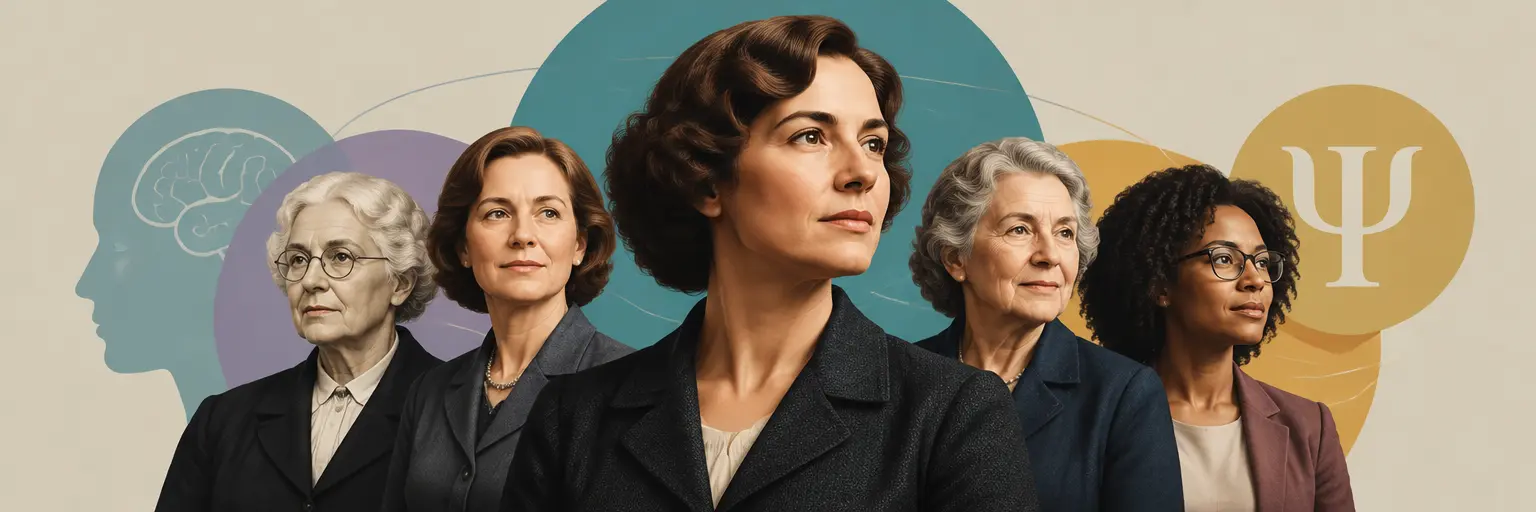
While history often highlights male figures like Freud, Skinner, or Piaget, the story of psychology is incomplete without the groundbreaking work of women. From the earliest days of the discipline to modern research labs, female psychologists have challenged prevailing theories, developed new therapeutic approaches, and expanded our understanding of human development, social behavior, and mental health. This subcategory celebrates their resilience, intellectual courage, and lasting influence—offering students and curious readers a deeper appreciation for the diverse minds that built modern psychology.
🧠 Early Trailblazers: Overcoming Barriers to Entry
At the turn of the 20th century, women were largely excluded from academic psychology, yet a few refused to be silenced. Mary Whiton Calkins completed all requirements for a PhD at Harvard but was denied the degree solely because of her gender—still, she went on to become the first female president of the American Psychological Association in 1905. Similarly, Margaret Floy Washburn earned the first PhD in psychology awarded to a woman (from Cornell) and later led the APA herself, while authoring the influential The Animal Mind. These pioneers set a precedent for rigor and advocacy, proving that the capacity for scientific discovery knows no gender.
Their achievements were not just symbolic; they established the methodological foundations for child psychology, comparative psychology, and experimental ethics. Calkins developed the paired-associate technique for memory research, while Washburn championed the study of animal behavior as a legitimate scientific pursuit. Today, their names are honored in teaching awards and research centers, reminding us that institutional obstacles can be overcome with persistence. For students, exploring these figures reveals how systemic bias shaped early research priorities—and how these women reshaped them despite immense pressure.
👶 Developmental Psychology: The Mothers of Attachment and Social Learning
No discussion of child development is complete without Mary Ainsworth, whose “Strange Situation” procedure revolutionized our understanding of infant attachment. Her work, built on John Bowlby’s theory, identified secure, avoidant, and resistant attachment styles—concepts now foundational in clinical, educational, and parenting contexts. Similarly, Eleanor Maccoby challenged assumptions about gender differences in social behavior, demonstrating that peer influences and parental socialization play far larger roles than biology alone. These researchers moved psychology away from purely observational studies toward controlled experiments, offering empirical evidence for how early relationships shape lifelong emotional health.
Beyond attachment, figures like Carol Gilligan critiqued the male-centered morality theories of Lawrence Kohlberg, proposing that women often prioritize care-based ethics over abstract justice. Her book In a Different Voice (1982) sparked decades of research into gender and moral reasoning, reshaping developmental psychology and counseling practices. For learners, these contributions highlight that asking “different questions” can uncover entirely new dimensions of human experience. Understanding these models is essential for anyone pursuing clinical work, education, or family counseling, as they provide practical frameworks for interpreting behavior across the lifespan.
🛋️ Clinical and Therapeutic Innovations: Feminine Perspectives on Mental Health
Women psychologists have historically bridged the gap between scientific research and compassionate practice. Mamie Phipps Clark, alongside her husband Kenneth Clark, conducted the famous “doll tests” that revealed the damaging psychological effects of segregation on Black children—evidence that was cited in the landmark 1954 Brown v. Board of Education decision. Later, Judith Herman’s work on trauma and recovery introduced the concept of complex PTSD, shifting how clinicians understand survivors of prolonged abuse or domestic violence. Meanwhile, Anne Anastasi transformed psychological testing by emphasizing the role of culture and experience in intelligence, challenging purely hereditarian views.
In psychotherapy, women like Nise da Silveira brought art and occupational activities into treatment for schizophrenia, while Carl Rogers’ client-centered approach—though developed by a man—was deeply influenced by early female practitioners who advocated for egalitarian therapeutic relationships. Today, feminist therapy, systemic family therapy, and trauma-informed care all trace part of their lineage to these pioneers. For students, studying these contributions underscores that effective treatment is not just about technique but about cultural sensitivity, empowerment, and holistic understanding—values that remain central to ethical practice in modern psychology.
📈 Social Psychology: Expanding the Lens on Group Dynamics and Bias
Women have also been critical in uncovering how social environments shape individual behavior, particularly regarding prejudice and conformity. Henri Tajfel’s social identity theory was elaborated and tested extensively by female researchers like Naomi Ellemers, who examined in-group favoritism and the psychological costs of discrimination. Similarly, Carol Tavris’s work on the “mismeasure of woman” deconstructed myths about gender-based cognitive differences, exposing flawed methodology in earlier studies. These contributions are vital for understanding everything from workplace inequality to political polarization.
More recently, researchers like Susan Fiske have developed stereotype content models that predict how warmth and competence perceptions lead to envy, pity, admiration, or contempt—applicable in hiring, media, and intercultural relations. Women in social psychology also pioneered research on bystander intervention (as seen in the work of Bibb Latané and Judith Darley) and on the psychological effects of sexual objectification, as documented by Barbara Fredrickson’s objectification theory. For general readers, these insights help decode everyday interactions and provide a scientific basis for promoting inclusion and empathy in schools, organizations, and communities.
🔬 Cognitive and Biological Breakthroughs: New Frontiers by Women Scientists
In the realm of cognition and neuroscience, women have made remarkable strides. Eleanor Rosch (collaborating with Carolyn Mervis) introduced prototype theory, transforming our understanding of categorization and language—a cornerstone of cognitive psychology and artificial intelligence. More recently, neuropsychologist Brenda Milner’s famous studies of patient H.M. established the role of the medial temporal lobe in memory consolidation, earning her titles like “the founder of neuropsychology.” These discoveries were not peripheral; they are taught in every introductory psychology course today.
Additionally, researchers like Martha Farah have pioneered cognitive neuroscience of socioemotional functioning, while Candace Pert (though primarily a pharmacologist) discovered the opiate receptor, bridging psychology and biochemistry in the study of pain and emotion. Women have also led in developmental cognitive neuroscience, mapping how attention and executive functions mature across childhood. For students, examining these contributions reveals that rigorous empirical research is genderless—and that modern psychological science is a collaborative, global enterprise built on diverse intellectual perspectives. Understanding these breakthroughs prepares readers for advanced coursework in cognition, neuroscience, and computational psychology.
Frequently Asked Questions
Who was the first woman to receive a PhD in psychology?
Margaret Floy Washburn earned her doctorate in psychology from Cornell University in 1894, making her the first American woman to receive a PhD in psychology. She later became the second woman (after Mary Whiton Calkins) to serve as president of the American Psychological Association and is best known for her influential book The Animal Mind.
What is the Strange Situation procedure and who developed it?
The Strange Situation is a laboratory assessment designed by Mary Ainsworth in the 1970s to classify infant-caregiver attachment styles. It involves brief separations and reunions between a child and caregiver, revealing categories like secure, avoidant, and resistant attachment. This tool remains a gold standard in developmental psychology for predicting later emotional and social outcomes.
How did Mamie Phipps Clark contribute to the Civil Rights Movement?
Mamie Phipps Clark and her husband Kenneth Clark conducted doll tests where children chose dolls based on race, demonstrating that segregation instilled feelings of inferiority in Black children. Their research was cited in the U.S. Supreme Court’s 1954 Brown v. Board of Education decision, which declared racial segregation in schools unconstitutional.
Why is Carol Gilligan's 'In a Different Voice' considered a landmark work?
Carol Gilligan’s 1982 book critiqued Lawrence Kohlberg’s moral development stages for favoring abstract justice, arguing that women often use a care-based ethical perspective. This work challenged male-centric theories, sparked research on gender and morality, and influenced fields like developmental psychology, education, and feminist ethics.
What are the main contributions of Brenda Milner to neuropsychology?
Brenda Milner’s studies of patient H.M., who had hippocampal removal, revealed that the medial temporal lobe is critical for forming new long-term memories. Her groundbreaking research also identified separate systems for procedural and declarative memory, establishing foundations for modern cognitive neuroscience and amnesia research.