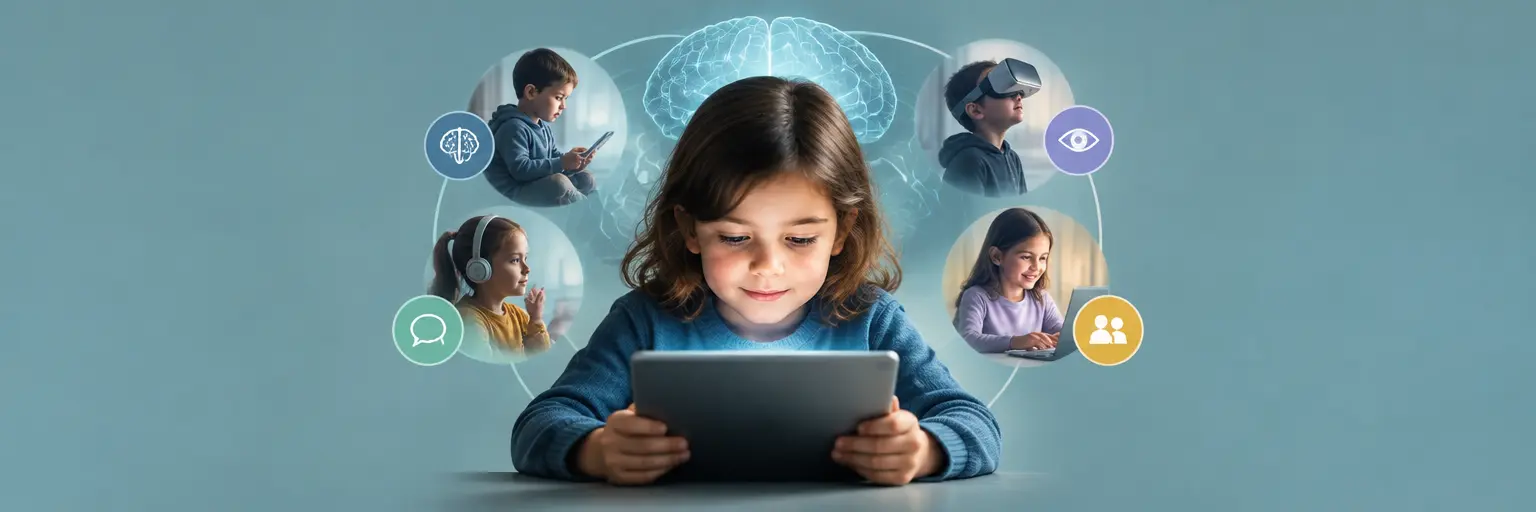
Understanding How Technology Shapes Human Development
In today’s digital-first world, technology is not just a tool—it is a developmental context. Within Developmental Psychology, the subcategory "The Impact of Technology on Development" explores how screens, social media, AI, and digital communication influence cognitive, social, and emotional growth from infancy through old age. For students and general readers of Psychology Basics, this page breaks down current research, practical implications, and age-specific effects, helping you understand both the risks and benefits of digital life.
🧠 Cognitive Development: Attention, Memory, and Learning in the Digital Age
Technology reshapes how children and adolescents process information. Studies show that interactive educational apps can enhance problem-solving and spatial skills, while passive screen time may reduce sustained attention and deep learning. The key is the type of engagement—active creation versus passive consumption. For students, multitasking with media often fragments working memory, making it harder to encode new knowledge. However, digital tools like adaptive learning platforms offer personalized pacing, which can accelerate mastery in math and reading.
Parents and educators should focus on quality over quantity. Encourage tech use that requires active responses, such as coding games or collaborative online projects, rather than endless scrolling. Research from developmental psychologists indicates that executive function—the ability to plan, focus, and switch tasks—can be strengthened with gamified training, but only when limits are set. The goal is to use technology as a scaffold, not a replacement for real-world exploration, which remains critical for neural pruning and synaptic growth.
📱 Social Development: Identity, Friendship, and Empathy in Virtual Spaces
Social media platforms have become primary arenas for peer interaction, especially during adolescence. Here, technology influences identity formation through curated self-presentation and social comparison. While online communities can provide support for marginalized youth, they also amplify fear of missing out (FOMO) and cyberbullying risks. Developmental psychologists note that empathy development relies on nonverbal cues—tone, facial expression, and touch—which digital text often lacks, potentially slowing perspective-taking skills.
However, video chat and multiplayer games do offer rich social feedback, allowing for laughter, shared goals, and conflict resolution. The critical factor is synchronous communication versus asynchronous posting. For healthy social development, families should model balanced tech use, and schools can teach digital citizenship—how to read tone, manage privacy, and rebuild trust after online misunderstandings. Adolescents who learn to navigate virtual friendships without abandoning face-to-face interactions tend to show higher self-esteem and lower loneliness.
🎮 Emotional Regulation and Screen-Based Stress
Constant notifications and algorithm-driven content can dysregulate the stress response. For children, rapid pacing and surprising sounds in apps trigger dopamine loops, making delayed gratification harder to practice. Emotional regulation—the ability to calm oneself after frustration—is often underdeveloped when screens are used as pacifiers. Conversely, digital mental health apps with guided breathing or mood tracking can teach teenagers to label emotions and choose coping strategies, serving as portable therapeutic tools.
The impact of technology on sleep is another emotional lever. Blue light suppresses melatonin, and late-night social media use reduces REM sleep, which is essential for mood stability. Developmental psychologists advise tech-free wind-down routines at least 30 minutes before bed. For younger kids, replacing tablet time with physical play or reading aloud helps them practice soothing themselves without external triggers. By setting consistent boundaries, caregivers can turn technology from a stressor into a self-regulation aid.
👶 Early Childhood: Screen Time Guidelines and Sensorimotor Growth
In the first five years, the brain develops rapidly through sensorimotor activity—touching, moving, and interacting with physical objects. Excessive screen exposure during this window is linked to delays in language acquisition and fine motor skills. The American Academy of Pediatrics recommends no screens before 18 months except video chatting, and limited, co-viewed content for toddlers. Co-viewing is key: when a parent talks about what is on screen, vocabulary grows just as much as from reading books.
Interactive touchscreens can support cause-and-effect learning, but they cannot replace the proprioceptive feedback of building blocks or crayons. For healthy development, technology should be adjacent to play, not central. For example, an app that colors a picture can be followed by real coloring with paper to reinforce hand strength. Caregivers who narrate their own actions while using phones—"I am paying a bill now"—help children understand that devices are tools, not companions. This foundation prevents later addictive tendencies.
🧑💻 Adolescence and Emerging Adulthood: Digital Identity and Risk-Taking
During adolescence, the prefrontal cortex is still maturing, making teens more sensitive to peer approval and novelty—both amplified by social media. Technology here drives identity experimentation, from trying new names to exploring subcultures, which is developmentally positive. Yet photosharing raises risks of body image dissatisfaction and comparison-based anxiety. Emerging adults use dating apps and professional networks, blurring boundaries between private and public selves, and learning to manage digital footprints.
Risk-taking behavior also shifts online. Participating in viral challenges or sharing risky content can provide fast rewards but long-term consequences. Developmental psychologists encourage open conversations about failure—both online and offline—so teens understand that a post can be deleted but not forgotten. Schools that integrate media literacy into curriculum help students spot misinformation, which builds critical thinking. When technology is used to explore prosocial causes—like climate activism or volunteer coordination—it becomes a powerful vehicle for developing a mature, civic identity.
👵 Lifespan Perspectives: Aging, Cognitive Reserve, and Social Connection
At the other end of the spectrum, technology impacts older adults by supporting cognitive reserve through memory games, language learning apps, and health tracking. Digital puzzles can slow age-related decline in processing speed, though they do not prevent dementia. More importantly, video calls reduce social isolation, which is a major risk factor for depression and physical illness in late life. Smart home devices can provide safety reminders, but they must be designed with large fonts and simple interfaces to be usable.
The digital divide is a developmental justice issue: older adults without access are left out of telehealth and family group chats. Training programs that pair younger volunteers with seniors have shown remarkable success in boosting confidence and neural plasticity. From a lifecourse perspective, learning new tech skills at any age activates the hippocampus, promoting neurogenesis. Therefore, technology viewed as a lifelong learning partner, rather than a youth-only tool, enhances well-being across decades.
📚 Frequently Asked Questions
Does screen time permanently damage a child’s brain?
No, but excessive passive screen time can delay certain skills, especially language and attention regulation, particularly under age two. The brain is plastic, so with reduced screens and increased interactive play, children often catch up. The key is not permanent damage but lost practice time for foundational behaviors. Following age-based limits and encouraging co-viewing mitigates most risks.
Can technology improve social skills in shy children?
Yes, if used deliberately. Platforms like moderated role-playing games or video chatting with known relatives allow shy children to rehearse conversations with lower anxiety. However, transfer to face-to-face settings works best when parents debrief after online interactions, pointing out nonverbal cues they missed. Without that bridge, digital socializing may become a comfort zone that avoids real-world practice.
What is the healthiest amount of daily tech use for a teenager?
Research suggests two to three hours of recreational screen time per day is a reasonable upper limit for teens, provided sleep, physical activity, and schoolwork are met. More important than exact hours is content quality and whether tech is interfering with meals or sleep. Weekly digital detoxes, like tech-free dinners, help maintain balance without causing rebellion.
How can parents reduce tech-related tantrums in toddlers?
Use a "one-in, one-out" rule: before starting screen time, agree on an ending activity, such as a song or a timer. Offer a physical alternative immediately after the screen ends, like building blocks or a walk. Avoid using screens as rewards or withdrawals, because that increases their emotional value. Consistent, calm boundaries teach toddlers that transitions are normal, not punishing.
Does using AI chatbots for homework harm cognitive development?
It depends on usage. If students copy answers without doing the thinking, it undermines practice and retention. But if they use AI like a tutor—asking for explanations, generating practice problems, or checking their logic—it can deepen understanding and foster metacognition. The developmental harm comes from learned helplessness, not the tool itself. Parents and teachers should guide students to use AI as a collaborator, not a replacement for their own reasoning.