The Gambler's Fallacy: Why We Think Past Events Influence Future Ones
🤔 Discover the Gambler's fallacy psychology explained: We mistakenly believe past random events predict future ones, like assuming a roulette wheel's "due"…
Read article
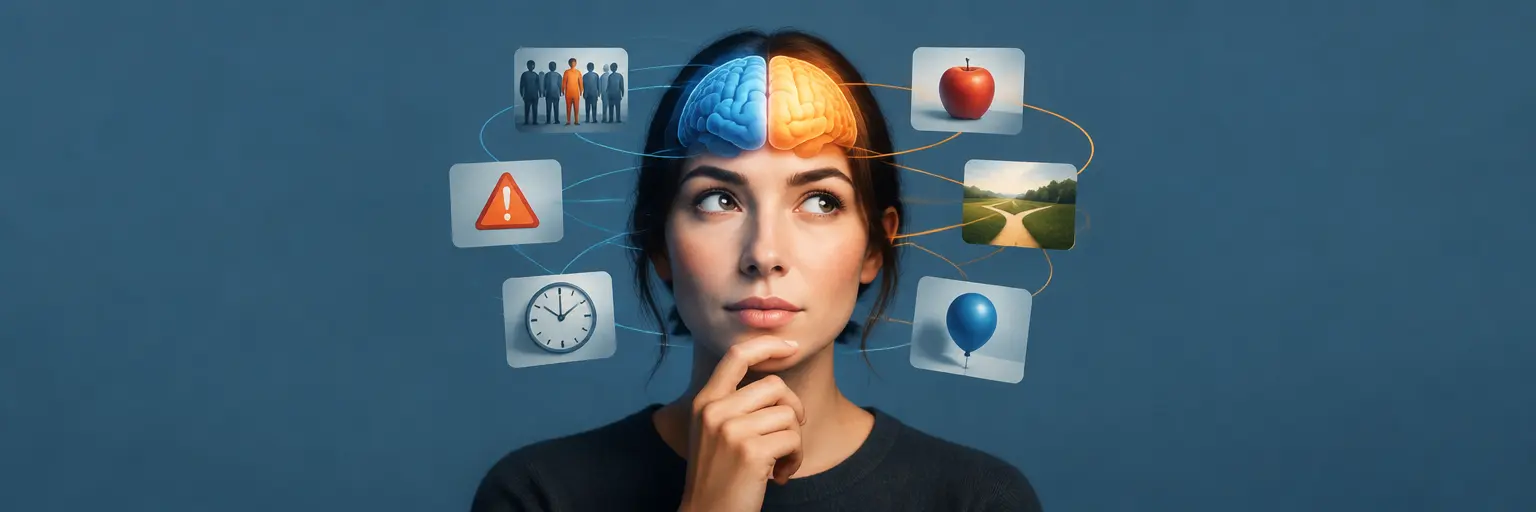
🧠 Cognitive Biases are the mental shortcuts our brains use to make quick decisions—but they often lead us astray. These systematic patterns of deviation from rational judgment shape everything from how we remember the past to how we predict the future. Understanding these biases is essential for anyone exploring cognitive psychology, as they reveal the fascinating, yet flawed, machinery behind human thought. By learning to recognize biases like confirmation bias, anchoring, or the availability heuristic, you can improve critical thinking, avoid common pitfalls in reasoning, and make better everyday choices. 🌟 Dive into the core of how your mind works and unlock the hidden influences behind your perceptions and decisions—perfect for students and curious readers alike.

🤔 Discover the Gambler's fallacy psychology explained: We mistakenly believe past random events predict future ones, like assuming a roulette wheel's "due"…
Read article
🤔 Ingroup bias explained simply: We naturally favor those we perceive as "like us," often unconsciously prioritizing our own group's needs and…
Read articleWelcome to the Cognitive Biases subcategory of Psychology Basics. Here, you’ll explore the systematic patterns of deviation from norm or rationality in judgment—mental shortcuts that shape how you perceive, decide, and remember. These biases are not flaws but evolutionary adaptations, yet they profoundly influence everyday choices, from buying a car to forming political opinions. This page offers a clear, structured guide for students and curious readers, breaking down the most influential biases, their real-world consequences, and practical ways to mitigate them. Optimized for learning and search visibility, each section delivers essential insights without overwhelming jargon.
Cognitive biases are predictable thinking errors caused by your brain’s attempt to simplify information processing. Coined by Amos Tversky and Daniel Kahneman, these heuristics (or rules of thumb) help you act quickly but often lead to systematic mistakes. For example, the availability heuristic makes you overestimate risks like plane crashes because vivid news stories come to mind easily, while underestimating common ones like car accidents. Understanding these patterns is crucial because they affect judgment in law, medicine, finance, and personal relationships.
For students and general readers, recognizing biases is the first step toward better critical thinking. Instead of blaming yourself for “irrational” choices, you’ll see them as universal human tendencies. This knowledge empowers you to pause, question your assumptions, and seek more objective evidence. Moreover, biases influence social dynamics—such as stereotyping or groupthink—so learning about them enhances both personal growth and civic engagement. Expect to leave this section with a mental toolkit for spotting bias in yourself and others.
Daniel Kahneman’s research introduced three foundational heuristics. The anchoring effect occurs when you rely too heavily on the first piece of information (the “anchor”)—for instance, a high initial price makes a later discount seem like a bargain. The availability heuristic, as mentioned, judges likelihood based on how easily examples come to mind. Meanwhile, the representativeness heuristic leads you to classify things based on similarity to a prototype, ignoring base rates—like assuming someone who loves reading is an academic librarian rather than a salesperson.
These biases are not just laboratory curiosities; they shape real decisions daily. In negotiations, smart professionals use anchoring to set favorable starting points. Marketers exploit availability by making product benefits memorable. And in everyday reasoning, representativeness fuels stereotypes. By learning these patterns, you’ll become aware of when your intuition might lead you astray. Practical exercises—such as asking yourself “What’s the base rate?” or “How did I get this anchor?”—can significantly reduce errors in judgment, making you a sharper thinker.
Your ego protects itself through several powerful biases. The overconfidence effect makes you overestimate your knowledge or abilities—think of drivers who rate themselves above average. Hindsight bias (“I knew it all along”) distorts memory so that past events seem predictable, which can hinder learning from mistakes. Additionally, the self-serving bias attributes successes to internal factors (your skill) and failures to external ones (bad luck), preserving self-esteem but blocking personal growth.
These biases are particularly important for students because they affect feedback processing. If you blame a poor grade on an unfair test, you miss opportunities to improve. Recognizing self-serving biases helps you accept constructive criticism and adopt a growth mindset. For professionals, overconfidence can lead to costly errors in investments or medical diagnoses. By actively seeking disconfirming evidence and keeping a decision journal, you can counterbalance these tendencies. Expect practical strategies to reduce ego-driven blind spots in your academic and career life.
Humans are social creatures, and biases often emerge in group contexts. Conformity bias makes you align your beliefs with others to fit in, famously demonstrated in Solomon Asch’s line-length experiments. Ingroup favoritism leads you to perceive your own group as superior, fueling discrimination and conflict. More dangerously, groupthink occurs when the desire for harmony overrides critical thinking—leading to poor decisions like the Challenger space shuttle disaster or flawed military strategies.
Understanding these social biases is vital for teamwork and leadership. In academic settings, group projects can suffer from groupthink if members suppress dissent. By encouraging devil’s advocacy and anonymous feedback, groups can improve decision quality. For citizens, recognizing ingroup favoritism helps you challenge political polarization and prejudice. This section offers frameworks for fostering inclusive environments where diverse viewpoints are valued, not suppressed. You’ll learn to spot signs of unhealthy conformity and promote psychological safety in any collaborative setting.
While you cannot eliminate cognitive biases entirely, you can reduce their impact. Techniques include premortem analysis—imagining a future failure to identify risks—and considering the opposite by actively searching for disconfirming evidence. Structured decision-making, such as using checklists, reduces reliance on memory-prone heuristics. Additionally, slowing down and reflecting on your reasoning helps counter fast, intuitive judgments. For everyday use, creating “if-then” plans (implementation intentions) can automate better choices.
This section bridges theory to practice, showing how bias awareness improves finance (avoiding sunk cost fallacy), health (overcoming optimism bias), and relationships (reducing fundamental attribution error). For students, learning these skills enhances exam performance and research methodology. For general readers, it fosters resilience against misinformation and advertising manipulation. Expect actionable steps, including journaling templates and decision matrices, that you can implement immediately. Remember, the goal is not perfection but incremental improvement in your critical thinking abilities.
A heuristic is a mental shortcut that speeds up decision-making, such as using a rule of thumb. A cognitive bias is the systematic error that results from relying on heuristics inappropriately. For example, availability is a heuristic, but availability bias occurs when you overweigh vivid examples over statistical facts. All biases stem from heuristics, but not every heuristic produces a bias.
No, they cannot, because they are deeply wired into how the brain processes information. However, you can reduce their influence through awareness, deliberate practice, and structured decision-making. Techniques like debiasing training, accountability, and using decision checklists have shown moderate success. The goal is to manage bias, not erase it, by slowing down and considering alternative perspectives when stakes are high.
Biases like hindsight and confirmation bias actively distort what you remember and how you interpret new information. For instance, your current beliefs can cause you to selectively recall supporting memories and ignore contradictory ones. This creates a self-reinforcing loop where biased perception strengthens existing biases, making it harder to update your worldview even with new evidence.
Not always. Many biases have evolutionary benefits—they help you make quick decisions in uncertain environments. For example, the optimism bias motivates action despite risks, and the halo effect aids in rapid social judgments. However, in modern contexts, these can lead to poor choices or unfair treatment. The harm depends on the situation, so context-aware application is key.
Key ones include confirmation bias (seeking evidence that supports your views), sunk cost fallacy (continuing a failing endeavor due to past investment), and the Dunning-Kruger effect (overestimating competence when unskilled). Also important are the framing effect (decisions influenced by how choices are presented) and the fundamental attribution error (overemphasizing personality over situation). Understanding these improves study habits and interpersonal skills.